Space distances & travel
How Far Is a Light-Year? Convert Light-Years to Kilometers and Miles
Convert light-years to kilometers, miles, AU and parsecs, compare nearby stars and explore light and spacecraft travel times.
Explore Celesiq
Explore planets, sunlight and the night sky with guides and interactive tools.
Try a broader search, choose another topic or reset the filters to browse every guide.
Space distances & travel
Convert light-years to kilometers, miles, AU and parsecs, compare nearby stars and explore light and spacecraft travel times.
Planets & orbits
See Jupiter’s current distance, explore its changing orbital geometry and find the next closest approach and one-way light delay.
Night sky
Find your local darkness start and end times, inspect a twilight timeline and see how many Moon-free observing hours are available.
Night sky
Compare a year of Galactic Core opportunities for your location, choose the best nights and explore Moon-free dark-sky windows.
Planets & orbits
Find Earth’s current orbital position, travel through time and explore the seasons, changing distance and orbital speed.
Night sky
Find the Moon’s rising bearing for your location, explore the horizon and compare 30 days of changing moonrise directions.
Sunlight & the Sun
Zoom from the Sun to a tiny Earth, compare diameter and volume, and see how a basketball and tiny pinhead represent their sizes.
Planets & orbits
Compare the eight planets’ mean speeds and explore why they speed up near the Sun with an interactive elliptical orbit.
Space travel
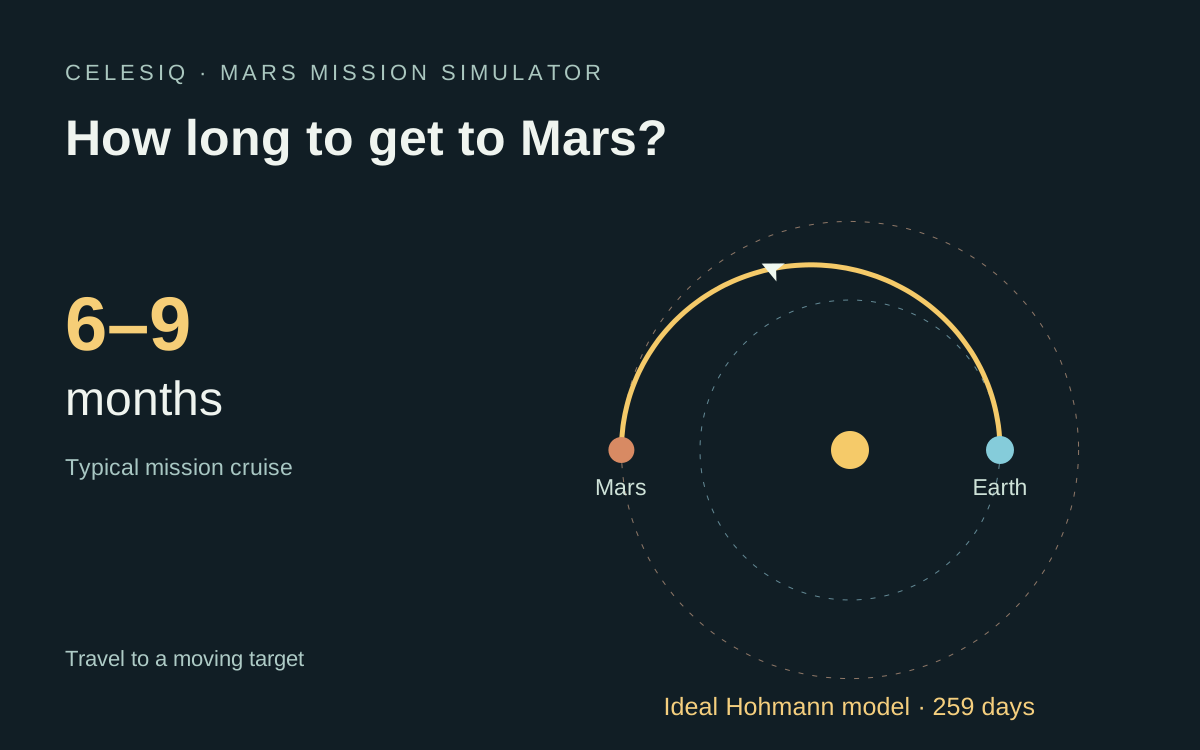
Follow a moving-target transfer, compare launch-date geometry and explore how long real NASA missions took to reach Mars.
Planets & orbits
Compare sidereal and solar days, race the eight planets and see why a day can last longer than a year.
Planets & orbits
Compare all eight planets by volume, see their disks on one diameter scale and explore how many Earth volumes each world contains.
Planets & orbits
Rank all seven planets by their distance from Earth, explore other dates, and distinguish today’s nearest planet from the closest on average.
Planets & orbits
See the current distance, move through dates, explore a distance chart and compare one-way light delays.
You in space
Compare your Earth jump across eight planets, the Moon and dwarf planet Pluto, with shared-scale jump animations.
You in space
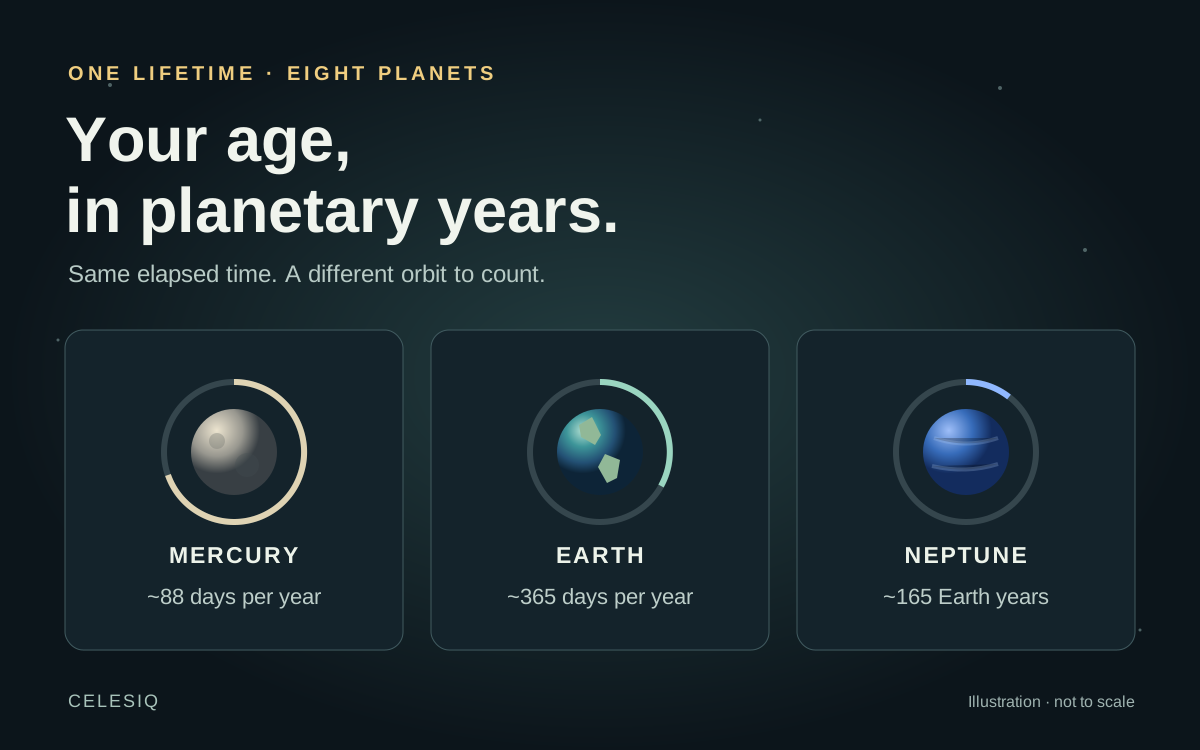
Enter your birthday, compare eight planets plus Pluto, and explore completed orbits and progress through your next year.
You in space
Compare your Earth reading across eight planets, the Moon and Pluto, and discover the difference between mass and weight.
Sun & light
Watch accelerated light signals, compare arrival times, and explore how distance changes the journey from the Sun.
Sun & light
Compare solar irradiance across all eight planets plus Pluto, adjust the distance, and explore the inverse-square law with an interactive graph.
Sun & light
Compare calculated solar disks, explore all eight planets plus Pluto, and adjust the distance to understand angular size and sunlight.
Planets & orbits
Explore the eight planets with a date-based orbit tool, calculated solar distances, and a practical guide to planetary motion.
Night sky
Estimate Galactic Core conditions, compare viewing times in UTC, and explore how the Moon and your chosen sky darkness affect the view.
Night sky
Identify the bright star or planet near the Moon from your location with a local sky visualization that shows the object on the correct side of the Moon.
Night sky
Check whether Venus is the bright object from your location and learn why the planet can outshine every star in the twilight sky.
Night sky
Check moonrise, moonset, Moon phase and whether the Moon is currently above your horizon with a location-based quick check.
Night sky
Check tonight's Moon phase, illumination percentage and waxing or waning direction with a clear visual guide.
Night sky
Check whether Mercury, Venus, Mars, Jupiter or Saturn may be visible tonight and learn how to recognize bright planets in the sky.
Night sky
Check the next likely visible ISS pass from your location and learn why the station is easiest to spot near sunrise or sunset.