Venus can be close to Earth
Venus is our nearest planetary neighbor during favorable parts of its orbit. Even though it is much smaller than Jupiter, its closeness helps it look extremely bright from Earth.
Venus visibility guide
If you see a dazzling "star" after sunset or before sunrise, there is a good chance it is Venus. This guide explains why Venus can look so bright and lets you check whether Venus is actually visible from your location tonight.
Quick answer
Venus is so bright because it is close to Earth compared with the stars, wrapped in highly reflective clouds, and often bright enough to stand out in twilight. When Venus is far enough from the Sun in the sky and high enough above your horizon, it can outshine every star.
Smart check
Enter a city, coordinates, or use your browser location. The check estimates Venus altitude, Sun altitude, elongation from the Sun and the best local viewing moment in the next 24 hours.
For the easiest naked-eye view, look for Venus when the Sun is below the horizon, Venus is still high enough above buildings or haze, and the sky is darkening or brightening rather than fully washed out.
Venus is not a star. It is a nearby planet reflecting sunlight. Three things make it look unusually bright: it comes relatively close to Earth, its thick cloud layer reflects a large amount of sunlight, and it can appear in a part of the sky where there are no stars bright enough to compete with it.
That is why people often search for "bright star tonight" when the answer is actually Venus. If the object is very bright, steady, and low-to-medium in the western evening sky or eastern morning sky, Venus is a strong candidate.
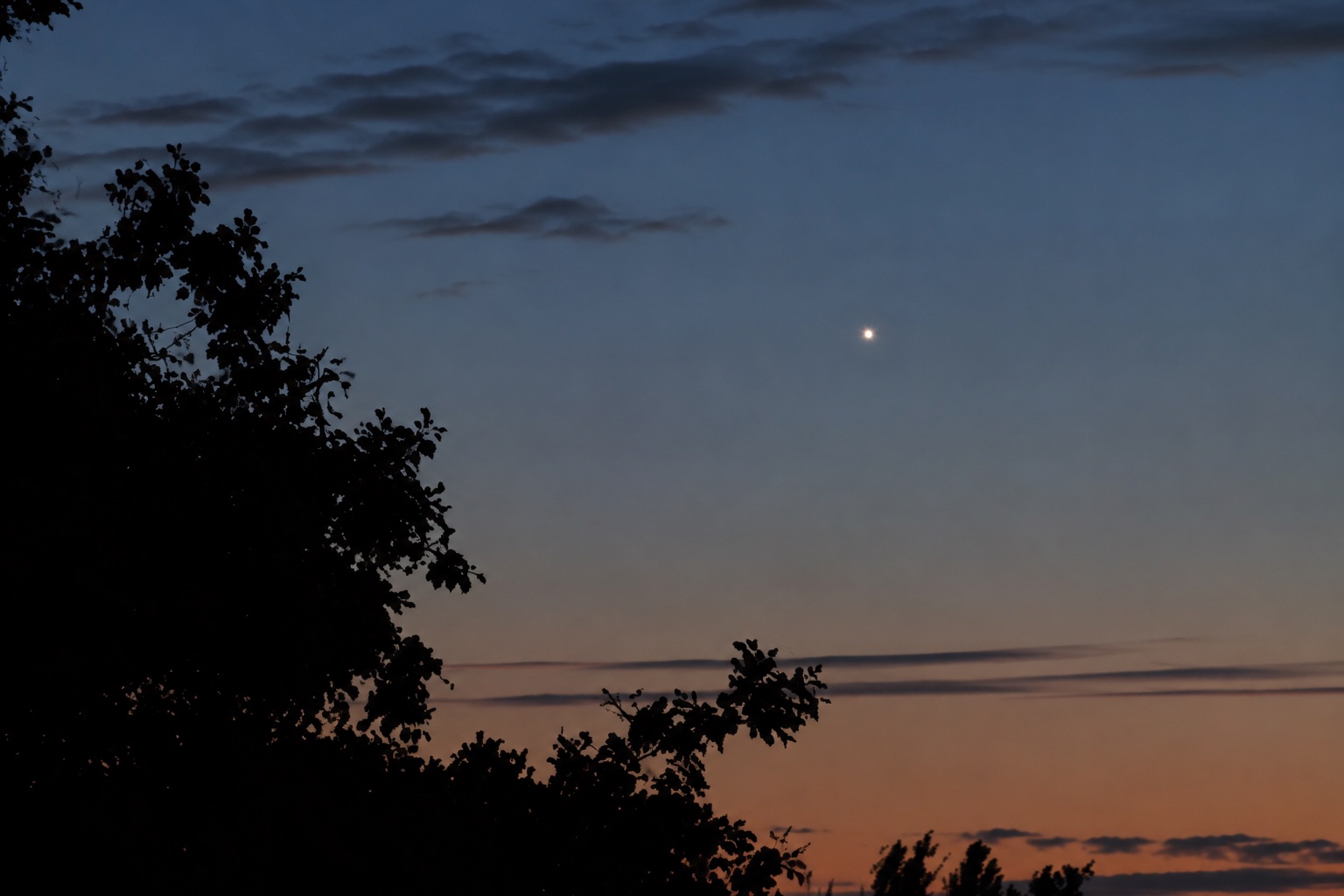
Venus is our nearest planetary neighbor during favorable parts of its orbit. Even though it is much smaller than Jupiter, its closeness helps it look extremely bright from Earth.
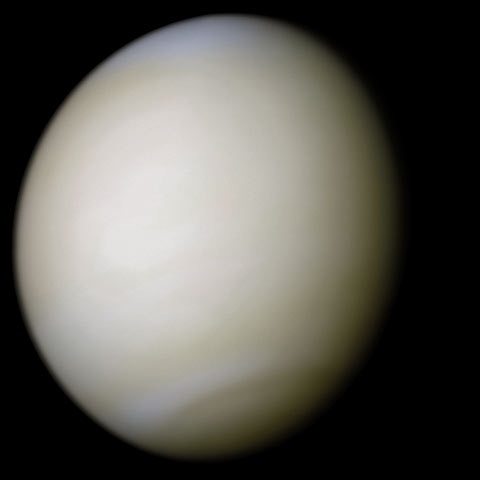
Venus is wrapped in thick, bright clouds that reflect sunlight very efficiently. This high reflectivity is a major reason Venus can dominate the twilight sky.
Venus is frequently seen shortly after sunset or shortly before sunrise. Against a fading or darkening sky, the contrast can make it look even more dramatic.
Like the Moon, Venus has phases. It can look very bright even as a crescent because it may be closer to Earth at that time, so the apparent disk is larger.
Venus orbits closer to the Sun than Earth does. From our point of view, that means Venus never wanders very far from the Sun in the sky. When it is east of the Sun, it can shine after sunset as the "evening star." When it is west of the Sun, it can shine before sunrise as the "morning star."
So Venus does not always follow the Sun below the horizon. During an evening-star period, Venus sets after the Sun and can remain visible in the western twilight. During a morning-star period, Venus rises before the Sun and may already be below the horizon, or lost in daylight, by the time sunset arrives.
If Venus appears too close to the Sun from Earth's point of view, it is hidden in glare or daylight. The important angle is called elongation: the apparent separation between Venus and the Sun in the sky. Larger elongation usually gives you a better chance to see Venus against darker sky. You can also compare that geometry on the Celesiq Solar System map, which shows Venus moving inside Earth's orbit around the Sun.
It might be Venus if the object is very bright, steady and does not blink like an aircraft. Venus can be much brighter than Sirius, the brightest star in the night sky. Jupiter can also be very bright, so the safest answer is to check the live sky geometry for your location.
Use the smart check above or open the full Celesiq map to compare Venus with the Sun, Moon and other planets at the same moment.
If you are trying to identify Venus without a telescope, focus on how the object behaves in the sky. Venus is bright and planet-like, but its timing and position near sunrise or sunset are often the clearest clues.
Sometimes, yes, but it is not a beginner-friendly target. Venus can be bright enough for daylight visibility when it is well separated from the Sun and you know exactly where to look. However, never scan near the Sun with binoculars, a telescope or your eyes. Looking toward the Sun can cause permanent eye damage.
For casual observing, wait until after sunset or before sunrise. That is when Venus is much easier and safer to identify.
Brightness is not the same as easy visibility. Venus may be extremely bright but still hard to see if it is only a few degrees above the horizon. Haze, buildings, trees and twilight can hide it. A higher Venus with a darker sky is usually easier than a lower Venus that is technically bright but buried in glare.
The Venus quick check estimates whether Venus is well placed from your selected location by combining Venus altitude, Sun altitude, sky darkness and the apparent separation between Venus and the Sun.
Venus is bright because it is close compared with the stars, covered in reflective clouds and often positioned far enough from the Sun to stand out in twilight or darkness. When Venus is above your horizon and the Sun is low enough, it can outshine every star. That is why it is often mistaken for a bright star, even though it is a planet reflecting sunlight.
It may be Venus, especially if the object is extremely bright, steady and visible after sunset or before sunrise. Venus is a strong candidate when the object is in the western evening sky or eastern morning sky and does not flash like an aircraft. The quick check above compares Venus with your local horizon and the Sun so you can confirm it more confidently.
Venus is called the evening star when it is visible after sunset and sets after the Sun. It is called the morning star when it rises before the Sun. During a morning-star period, Venus may already be below the horizon by sunset, even if searches for "Venus visible tonight" make it sound like it should be an evening target.
Venus changes from evening object to morning object as it moves around its inner orbit. When it is east of the Sun in our sky, it can set after the Sun and appear after sunset. When it is west of the Sun, it rises before the Sun and is best seen before sunrise instead. That is why "Venus after sunset" and "Venus before sunrise" can both be correct at different times of the year.
Venus orbits inside Earth's orbit, so it stays relatively close to the Sun in our sky. That keeps it mostly in evening or morning twilight rather than high overhead at midnight. Outer planets such as Mars, Jupiter and Saturn can appear far from the Sun in the sky, but Venus cannot wander that far from the Sun from our point of view.
Venus usually looks steady because it appears as a small disk rather than a tiny point source. If the object is flashing red, green or white, it is probably an aircraft. Atmospheric turbulence can make any low object shimmer, but Venus does not blink like a plane.
Venus is usually brighter than Jupiter when both are well placed. Jupiter can still be very bright and is often one of the most obvious objects in the night sky, but Venus can look more dazzling because it is closer to Earth and reflects sunlight efficiently from its cloud tops.
Venus can sometimes be bright enough to see in daylight, but it is difficult and not a good beginner target. The risk is that Venus can appear near the Sun from our point of view. Never scan near the Sun with binoculars, a telescope or your eyes, because accidental Sun exposure can cause serious eye damage.
The quick check gives a focused answer for Venus. The full Celesiq map lets you compare Venus with the Sun, Moon, Mercury, Mars, Jupiter, Saturn and tracked spacecraft.
If the bright object is close to the Moon, open the what's next to the Moon tonight guide to check whether Venus or another bright object is beside the Moon from your location.
Open the interactive Celesiq sky map Check all visible planets